Neutrality isn’t virtuous when the issue is hate
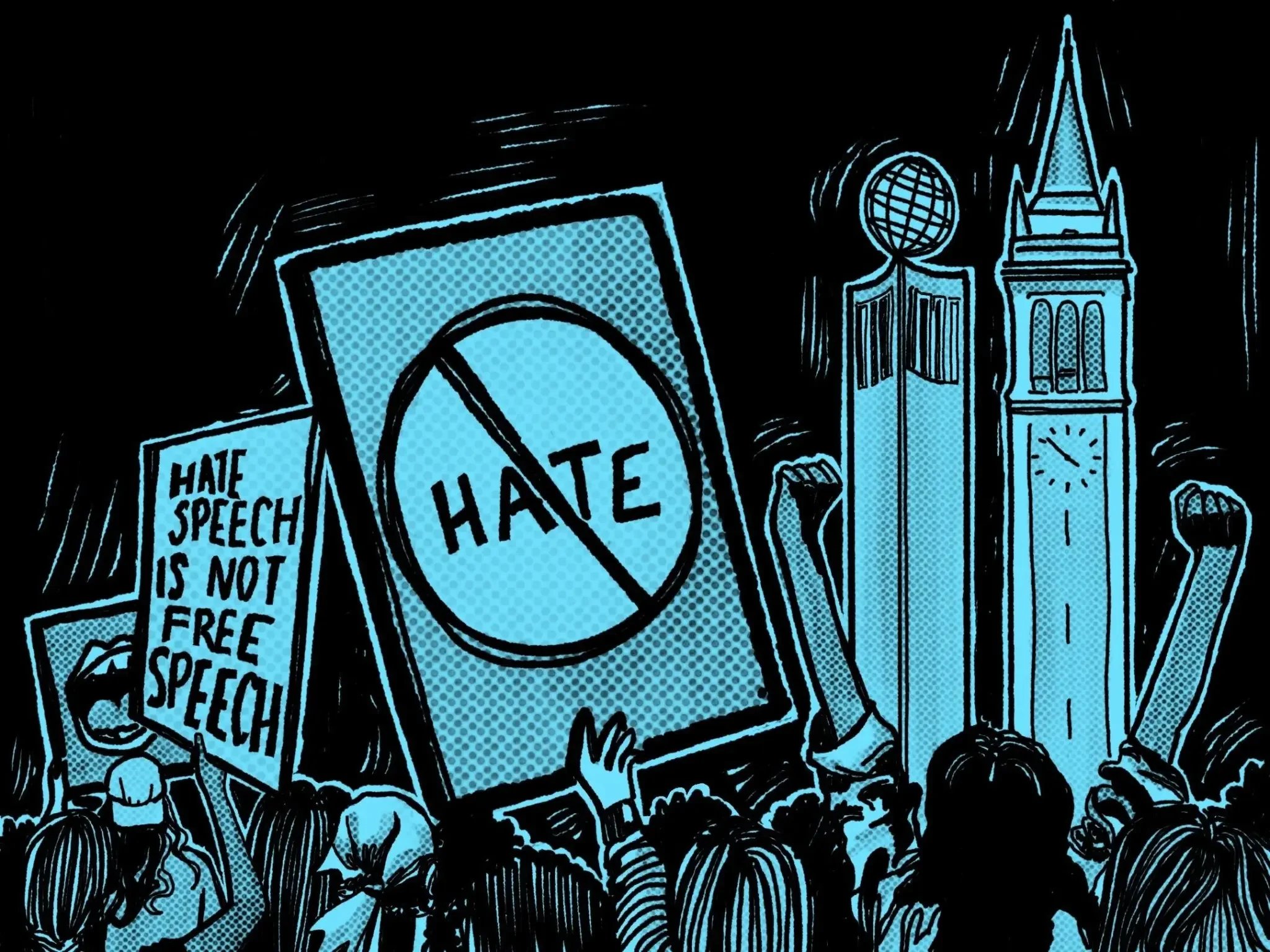
(Maggie Soennichsen / Daily Trojan)
Free speech has long been acknowledged as the moral cornerstone of American democracy — and, by extension, its universities. At its best, free speech is an ethical principle: a tool to protect dissent. In 1964, when UC Berkeley students launched the Free Speech movement, they wanted the freedom to oppose segregation, to protest the Vietnam War and to question the suppression of political activism on campus.
On Nov. 10, Berkeley again became a stage for national debate over “free speech.” The American Comeback Tour, resumed by Erika Kirk, widow of conservative Turning Point USA founder Charlie Kirk, concluded its cross-country circuit there. The event, promoted under the slogan “Free speech is only free if we use our voices,” was closed to the public and ticketed, a precaution after Charlie Kirk’s assassination at Utah Valley University.
Inside, the audience skewed older, drawn primarily by allegiance and not curiosity. While outside, students protested. By morning, headlines followed the now-usual script: “Justice Department to investigate UC Berkeley after protesters try to disrupt Turning Point USA campus event,” the Los Angeles Times reported.
Turning Point USA built its brand on vilifying those already vilified — educators, queer people, immigrants — under the pretense of defending “freedom.” Erika Kirk now extends that mission, presenting intolerance as courage and provocation as principle. What she supports as “free speech” is speech that harms, but harm cloaked in patriotism is still harm.
The First Amendment is meant to protect individuals from government censorship. It does not obligate universities to pedestalize those who deny others’ dignity. The moral purpose of free speech, what made it radical in the first place, was its capacity to confront power, not reinforce it.
In Texas, the Texas A&M University System has spent the past year narrowing what professors may say about race, gender identity and sexual orientation — even dismissing a lecturer after a student objected to a class that acknowledged more than two genders. Regents then moved to restrict any course from “advocating” race or gender ideology without presidential approval, placing entire fields of study under political oversight.
Yet, Berkeley students are the ones accused of silencing free speech.
Abolitionist Frederick Douglass called free speech “the great moral renovator of society.” For him, it was the means by which truth survived tyranny. When that principle is repurposed to justify speech that endangers or dehumanizes, something essential in the American promise breaks.
In academia, that rupture is quietly widening. Last month, USC launched its Open Dialogue Project, meant to model constructive debate across ideological divides. Its first workshop invited participants to discuss a question that should not need revisiting: “Should hate speech be free speech?”
The event description was polished and civic — attendees would “learn the ABCs of constructive conversation,” enjoy a free dinner, and engage with “experts in law, policy, and civil rights.”
But the premise itself reveals a kind of institutional amnesia. Universities are meant to be places where students interrogate injustice, not where injustice is reframed as a discussion prompt. Asking whether hate speech deserves protection is like asking whether cocaine should be sold at the farmer’s market. The form is neutral, but the effect is corrosive.
Sociologist Daniel Patrick Moynihan once warned that societies have a habit of “defining deviancy down” — adapting to what they once found intolerable. Under the guise of balance, universities are lowering the bar of what counts as permissible harm.
An October report by the Southern Poverty Law Center presented increases in hate speech correlate with rises in hate-motivated violence, especially as speech normalizes aggression against marginalized communities. Exposure to hateful rhetoric does not build resilience: It breeds desensitization and collapses the moral distance between words and actions.
Universities, eager to appear neutral, respond with calls for “viewpoint diversity.” But neutrality is not integrity. A campus that gives hate a platform under the banner of fairness does not defend freedom; it abandons judgment. The mission of higher education has never been to amplify all ideas equally but to teach students how to distinguish between critique and cruelty, between dissent and dehumanization.
The protests at Berkeley, and the backlash that followed, show the real divide isn’t between free speech and censorship. It’s between those who see speech as a responsibility and those who see it as a weapon. Free speech, as it was conceived, was an act of care: a means of holding the powerful to account and protecting the vulnerable.
The question isn’t whether students can “handle” offensive ideas; it’s whether institutions still remember what the principle of free speech was for. When hate becomes something to “discuss,” the conversation is already lost.
