I will vote for Newsom in 2028, but I won’t enjoy it
This article was originally written for the Daily Trojan, published Nov. 21, 2025.
Strategic brilliance isn’t the same thing as committing to democracy and progress.
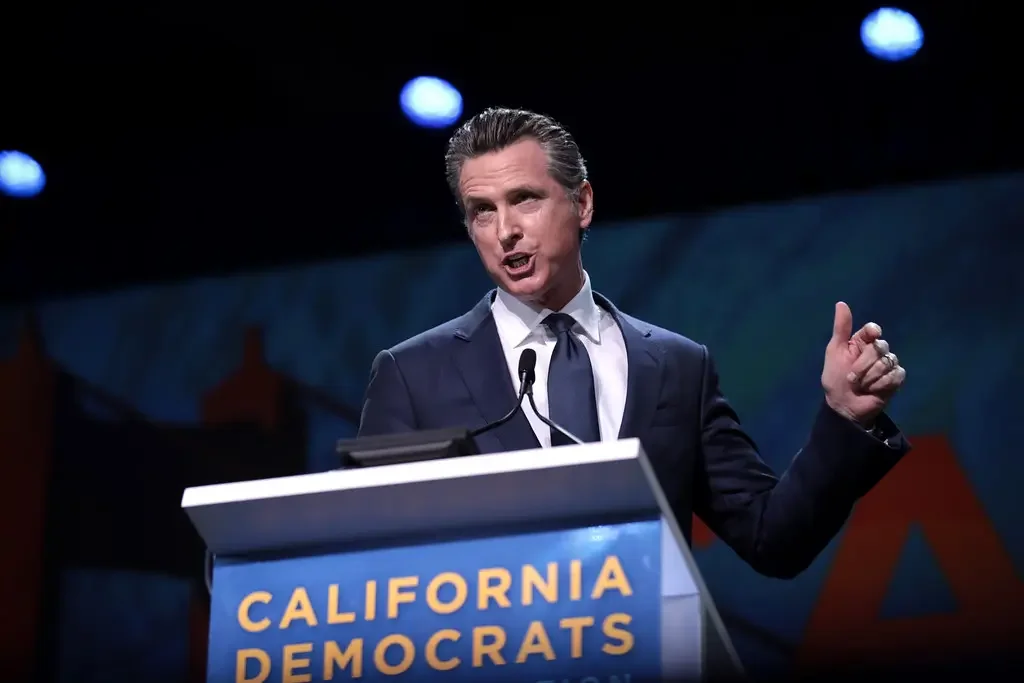
In order for democracy to truly make an impactful shift, it is not enough for the Democratic party to have a leader who is only half-heartedly dedicated to the public. (Gage Skidmore / Flickr)
Democrats have spent the last several election cycles warning that democracy is hanging by a thread, parroting that the party is the last line of defense. The message is so consistent that it has become the party’s emotional anchor, its moral north star, its reflexive answer to everything.
But living in California, the supposed blueprint for the Democratic future, it’s difficult not to notice how quickly that rhetoric calcifies — how the party is committed to protecting something, but that something is rather murky. The language remains elevated, but the outcomes it defends are often tactical choices that serve the party more than the principle.
Observing Gov. Gavin Newsom’s political trajectory and savvy has become rather disorienting. A presumed contender for the 2028 presidential race, Newsom invokes the need to defend democracy in various settings, from press conferences to podcasts and even throwaway Instagram captions. He rarely hesitates, but the clarity of his messaging isn’t the issue — the choices behind it are.
The weekend after Proposition 50 passed, creating five more Democratic-leaning congressional districts in California, Newsom took a victory lap in Texas. He flew into Houston, stood beneath a giant American flag and declared the moment a triumph for “the rule of law.” The crowd chanted “2028.” His grin made it clear the chant was neither new nor unwelcome.
But Newsom’s framing of Prop. 50 as a democratic safeguard, rather than as a strategic partisan exercise, exposed how quickly his definitions and morals shift depending on the outcome.
Prop. 50 began as a defensive measure against Texas’ mid-cycle gerrymander, but the speed with which Democrats embraced aggressive map-drawing of their own reveals how elastic their definition of “protecting democracy” has become. Californians are repeatedly told that liberal governance is synonymous with democratic protection, and few bother to challenge that logic.
They don’t need to, either, given that political science research has long shown that much of the polarized behavior Americans see from politicians is strategic rather than ideological.
In their book “Asymmetric Politics: Ideological Republicans and Group Interest Democrats,” political scientists Matt Grossman and David Hopkins detail how both parties amplify conflict in public because doing so advances their position, even when their private negotiations are far less extreme.
Newsom thrives in this environment. He draws sharp contrasts with Republican governors and speaks in sweeping terms about California’s role in defending democratic values. He is effective at it. He is also selective about which norms deserve this kind of rhetorical elevation.
However, Newsom’s public messaging about transparency and participation coexists with a governing approach in which major decisions are presented as conclusions rather than processes.
Ezra Klein’s recent analysis of the government shutdown for The New York Times argues that Democrats backed away from the “fight” because winning too decisively might weaken their leverage in the 2026 elections.
To Klein, the policy merits mattered, but only within the sphere of a broader strategic calculation. This same logic is visible in Newsom’s political prowess — if a move strengthens the party’s position, its democratic framing will follow. The framing is often secondary, but it lands with full force once delivered.
Living in Los Angeles makes it impossible to miss this pattern. A few blocks from campus, the gap between political assurances and everyday reality becomes sharper. Residents navigate housing pressures, infrastructure failures, environmental risks — issues shaped by state policy.
Newsom can articulate national stakes clearly, but the decisions most affecting Californians’ day-to-day tend to arrive fully formed, with little attempt to build consensus among the constituents he is in duty to serve, before the fact. Democratic participation enters the picture only after key decisions have been finalized.
For younger voters, this style lands differently than those who grew up with longstanding trust in the party. Even though establishment Democrats’ policies diverge from my own beliefs, I have still supported the party. I voted for Kamala Harris last year because I trusted the direction she represented.
Even so, when 2028 arrives, I will likely vote for Newsom if he is the Democratic presidential nominee, which with every passing day, seems increasingly feasible.
Yes, Democrats are right about the risks of authoritarian drift; they’re right to view the stakes as high — the alternative, a GOP-dominated America, remains alarming. But urgency cannot erase the distinction between defending democracy and defending a party’s dominance.
Newsom’s intelligence and discipline are political strengths — but they aren’t substitutes for democratic openness. If he intends to lead a national coalition rather than a party apparatus, he will need to show that he sees voters as actual participants instead of a constituency to be reassured after the fact.
Democracy doesn’t need more declarations about its fragility; it needs leaders willing to practice it. I’ll vote for Newsom — I’d just prefer the decision to feel like faith rather than obligation.
