My culture is not straight people’s costume
This article was originally written for the Daily Trojan, published Oct. 3, 2025.
The queer ‘uniform’ hasn’t vanished, but rather, it has become more socially mainstream.
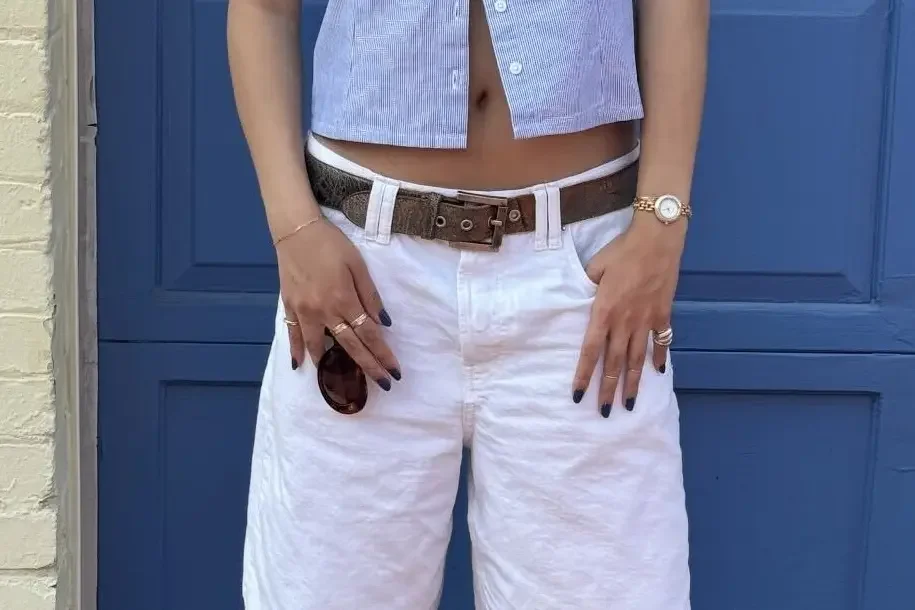
The queer trends that once held social significance have faded into the mainstream of straight fashion. (Julia Ho / Daily Trojan)
Last week, a girl I’ve been seeing deemed me an “unassuming gay.”
This isn’t the first time I’ve heard something like this because of my “straight-passing”-ness. I’ve ascertained, since then, that people weren’t questioning my style: My identity, not just in that moment, was both visible and invisible — seen everywhere, recognized nowhere.
It’s not that I dress “straight,” but because my carefully planned aspects of queerness in my appearance — chunky Docs, rings on every finger, jorts with baggy tees and oversized belts — were subsumed within the all-encompassing label of just “fashion.”
What felt like a personal slight is, in actuality, part of a much older story. October is LGBTQIA+ History Month, a reminder that queerness has never relied on words alone. For decades, clothing functioned as codes: thumb rings, colored laces threaded through boots, a carabiner clipped to a belt loop — each offered the possibility of recognition to those who understood the language.
These signals carried risk, and because they carried this burden, they also possessed substantial meaning. These symbols allowed people to find one another in environments where visibility was treacherous, and they worked because not everyone could discern them.
The lesbian carabiner is a case in point. A tool of climbing and construction, it became a subtle marker of identity when hooked to a belt loop, a signal that could be explained away if necessary. Among gay men in the 1970s, the “hanky code” served a similar function, with different colors tucked into back pockets to signify different desires.
These weren’t fashion choices in the casual sense; they were ways of making oneself known without being exposed. The language was imperfect — regional, shifting, sometimes misunderstood — but it was a language nonetheless, imperfect but alive, through clothing.
However, that language has grown harder to interpret. Over the past few decades, many of these once-coded items have migrated into mainstream fashion. Carabiners are now “gorpcore” accessories. Silver rings are recycled through the racks as part of a Y2K revival. Dr. Martens — once synonymous with gay protest — are now equally at home in a suburban back-to-school ad.
The very styles that once gave queerness distinction have been drained of their subversive charge and repackaged for mass consumption. The queer “uniform” has become indistinguishable from everyday fashion.
None of this is inherently bad; fashion evolves, and people are free to wear whatever they like. But when these stylistic choices circulate without their original context, they lose the specificity that once made them legible within the queer community.
This muddling of queer fashion follows a broader cultural pattern: Resistance aesthetics are welcomed only once they can be detached from their creators. Brazilian Havaiana flip-flops have been rebranded as minimalist Scandinavian footwear. South Asian dupattas resurface as Euro-summer scarves. ‘90s Black streetwear, rooted in hip-hop’s defiant politics, are “retro” looks.
The formula is always the same: Authenticity is tolerated only after its sanitization, its political edge dulled. For queer people, the consequences are sharper, since visibility has never been automatic. It was painstakingly constructed from fragile codes that signaled protection and connection.
On- campus, the contradiction can feel especially fraught. Yes, we have student organizations like the Queer and Ally Student Assembly and the LGBTQ+ Student Center — gay people galore! Last fall, I volunteered at the ONE Archives at the USC Libraries to explore the broader queer community and our history. Still, this is not enough.
Many of us continue to rely on aesthetic cues to locate one another: dressing in silhouettes that were traditionally perceived as menswear while simultaneously gracing the average masc lesbian’s wardrobe — penny loafers, oversized blazers and billowing trousers, for example. These can now be found at The Grove Aritzia on every employee.
It is tempting to see this diffusion as progress. After all, isn’t it a sign of acceptance that queer dress no longer marks difference, that style crosses boundaries without stigma? Maybe, but assimilation is not the same as liberation. When everyone adopts queer aesthetics without living queer lives, the effect is diluted. Queerness becomes just another borrowed trend, not an identity to be recognized.
Communities invent expressions of authenticity; the mainstream absorbs them; meaning dissipates. The cycle repeats. Queer people have always adapted — devising new codes when old ones were uncovered, creating new style vernacular when old words lost their connotation.
Ultimately, reinvention is a form of resilience. However, it can also be a burden. To continually invent legibility in the face of erasure is to live in a state of perpetual translation.
The jeopardy, then, is not disappearance in the conventional sense. Queer aesthetics are everywhere, from fast-fashion racks to luxury boutiques to algorithmically positioned TikTok trends.
The danger is dissolution into ubiquity — to be seen everywhere and recognized nowhere is its own cloak of invisibility. So, the question lingers within the queer community, and not for the first time: If everyone wears the “uniform,” how do we still find one another?
