The art of the buzzer-beater
This article was originally written for the Daily Trojan, published April 3, 2026 for its “Sports for Dummies” column.
An inquiry into why March Madness deviates from regular-season play — and our evaluation.

By JULIA HO & HEYDY VASQUEZ
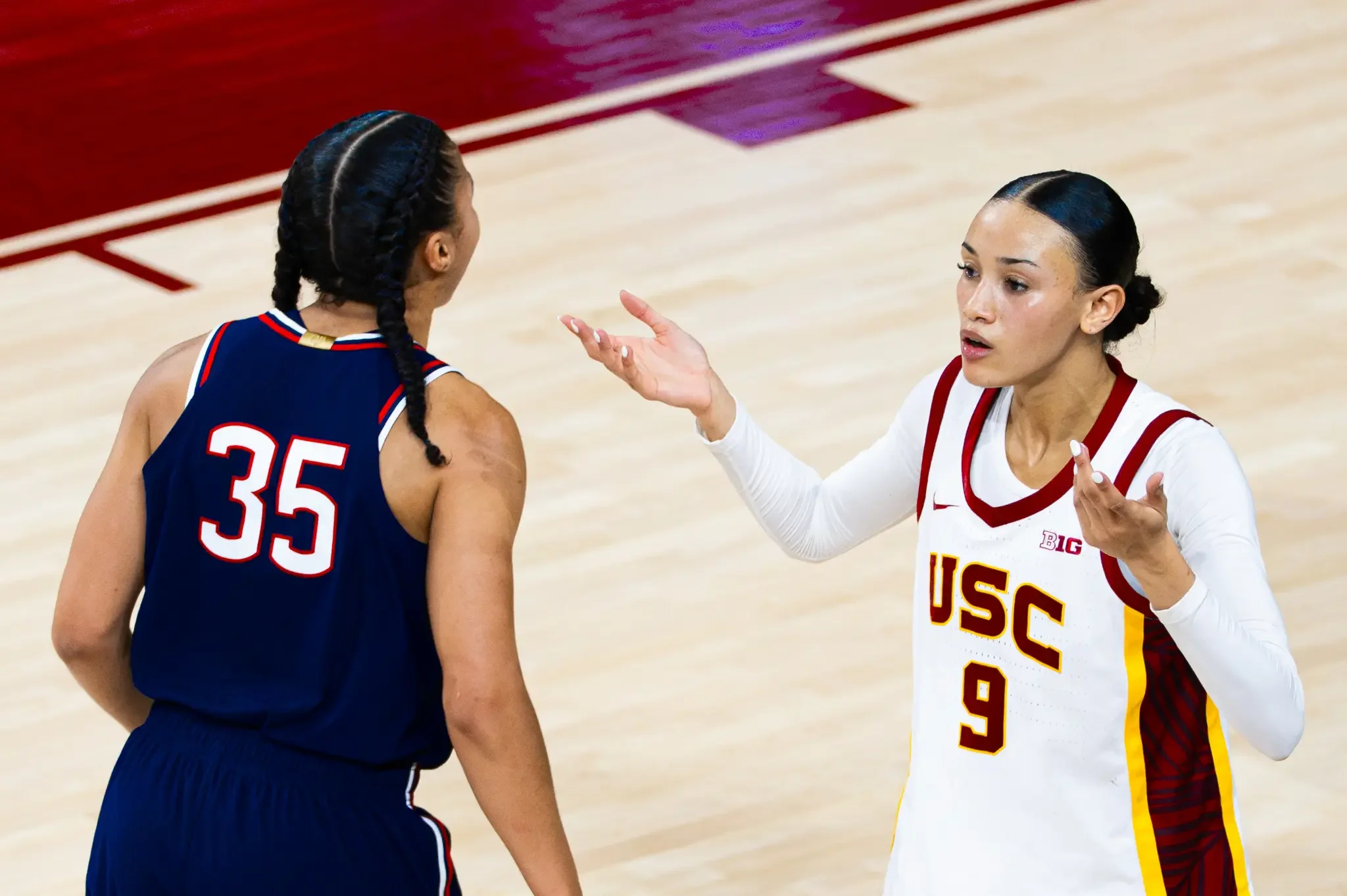
USC women’s basketball almost lost to Clemson in the first round of March Madness. Freshman guard Jazzy Davidson is pictured here in a match against UConn on Dec. 14, 2025. (Braden Dawson / Daily Trojan file photo)
March Madness is not about basketball.
This may sound controversial, but after careful observation — and several emotionally destabilizing nights watching TikTok edits of strangers hit miraculous shots at exactly 0.0 seconds on the clock — we feel confident in this conclusion.
The NCAA Tournament is not about strategy, defense or even athleticism. It is about timing. Specifically, the exact moment when an athlete launches a basketball toward the rim with the gall of someone who has nothing left to lose and suddenly, an entire state, or nation, believes in miracles again.
Unfortunately, our Trojans opted out of this spiritual experience.
The men’s basketball team finished its season quietly, long before the tournament began, demonstrating its commitment to inefficiency — albeit with the emotional fortitude that comes from witnessing a continuous, three-season-long floppage and knowing it will never end.
Meanwhile, the No. 9 women’s team made the tournament but exited in the Round of 32 after a 100-59 loss to No. 1-ranked South Carolina — the real ’SC.
While other teams were busy producing legacy-defining and edit-worthy moments, our Trojans were busy producing flops.
And yet, dozens of teams across the country continued to deliver havoc — or at least tried to.
This year’s tournament has featured an alarming number of buzzer-beaters — moments so dramatic they make the rest of the game feel like an extended warm-up. Experts — like the highly esteemed minds behind “Sports for Dummies” — attribute this trend to several key factors: players refusing to miss, defenders refusing to guard and the NCAA’s ongoing commitment to late-game chaos — now proudly sponsored by name, image and likeness deals.
Naturally, we felt obligated to rank these buzzer-beater dramatics using our highly sophisticated evaluation system, which measures athletic performance, emotional devastation, and the likelihood that someone screamed at or broke their television.
3. Alvaro Folgueiras sends Iowa past FLOP-rida
Trailing by 2 points with under five seconds remaining, Alvaro Folgueiras caught the ball in rhythm and drilled a 3-pointer to give the Iowa Hawkeyes men’s team a 73-72 win over the South Region No.1-seeded and reigning national champion Florida Gators, sending the Hawkeyes to their first Sweet 16 in over 25 years.
This game marked Iowa’s second-ever win against a No. 1 seed since tournament seeding began in 1979. More impressively, it was March Madness’ first game-winner in the last five seconds against a highly ranked seed since Kris Jenkins’ title-winning dagger in 2016 — clearly, buzzer-beaters of this caliber do not happen often, but when they do, people remember them forever.
2. Braylon Mullins sends UConn to Final Four
With Duke ahead by two points in the final seconds, Braylon Mullins pulled up from way beyond the arc and buried the game-winner to send the UConn Huskies to the Final Four, two years after winning the national championship. The possession only lasted a few seconds, but it preserved a season.
Statistically speaking, this was not UConn’s prettiest game by far. But in March, efficiency matters less than timing, and the freshman guard proved that four-tenths of a second is the only statistic anyone remembers.
1. The shot that never counted
Not every buzzer-beater ends in glory. Sometimes it ends in confusion, controversy and a disappointed referee holding a stopwatch.
Consider Clemson’s women’s team, whose season briefly reached euphoric heights when senior guard Mia Moore hit a running 3-pointer to best the Trojans in the first round of the tournament.
Then … the basket was erased. The score reverted to a tie, and the emotional whiplash was immediate. Clemson eventually lost in overtime, proving once again that in March Madness, joy is temporary and temporal limits can be overstepped.
And yet, despite the heartbreak, the tournament keeps delivering these moments. Fans only remember the final shot, not what happened in the first 39 minutes. Entire seasons collapse in a single bounce of the ball.
This is why March Madness continues to captivate us, year in and year out.
Not because the games are predictable, or because the best team always wins. But because, at any given moment, everything can change. A season can end. A hero can emerge. A devilish villain — usually wearing blue — can appear, reminding everyone that sustained excellence is impressive but also horribly irritating.
Looking at you, No. 1-seeded Duke men’s basketball. But who’s laughing now? Probably No. 2 UConn.
This is the real genius of the tournament. It convinces us, year after year, that destiny can be measured in decimals. That everything — months of practice, hours of film review, the support of thousands of fans — hinges on whether the ball leaves someone’s fingertips before the clock expires.
We firmly believe that the buzzer-beater is the most democratic moment in sports. It spurns rankings, recruiting classes and historical prestige all at once. It disregards how much money a program spent on facilities or how many banners hang in the rafters. In that final second, everyone is equally vulnerable to humiliation — or equally capable of glory.
So as the heart-wrenching tournament barrels toward its tumultuous conclusion, we offer this final insight to players, coaches and viewers: Do not relax. Do not celebrate early.
And under no circumstances should you assume the game is over until the clock says so, because in March — or now, April — time is not just a measurement.
It is a threat.
Julia Ho is a junior and an associate managing editor at the Daily Trojan. Heydy Vasquez is a senior and an Opinion editor at DT. Together, they write about sports for newcomers and skeptics alike in their column, “Sports for Dummies,” which runs every other Friday.
