The University didn’t just choose a president, it chose a legal strategy
This article was originally written for the Daily Trojan, published Feb. 6, 2026.
USC appointing Beong-Soo Kim as president is a sign of an era of risk management.
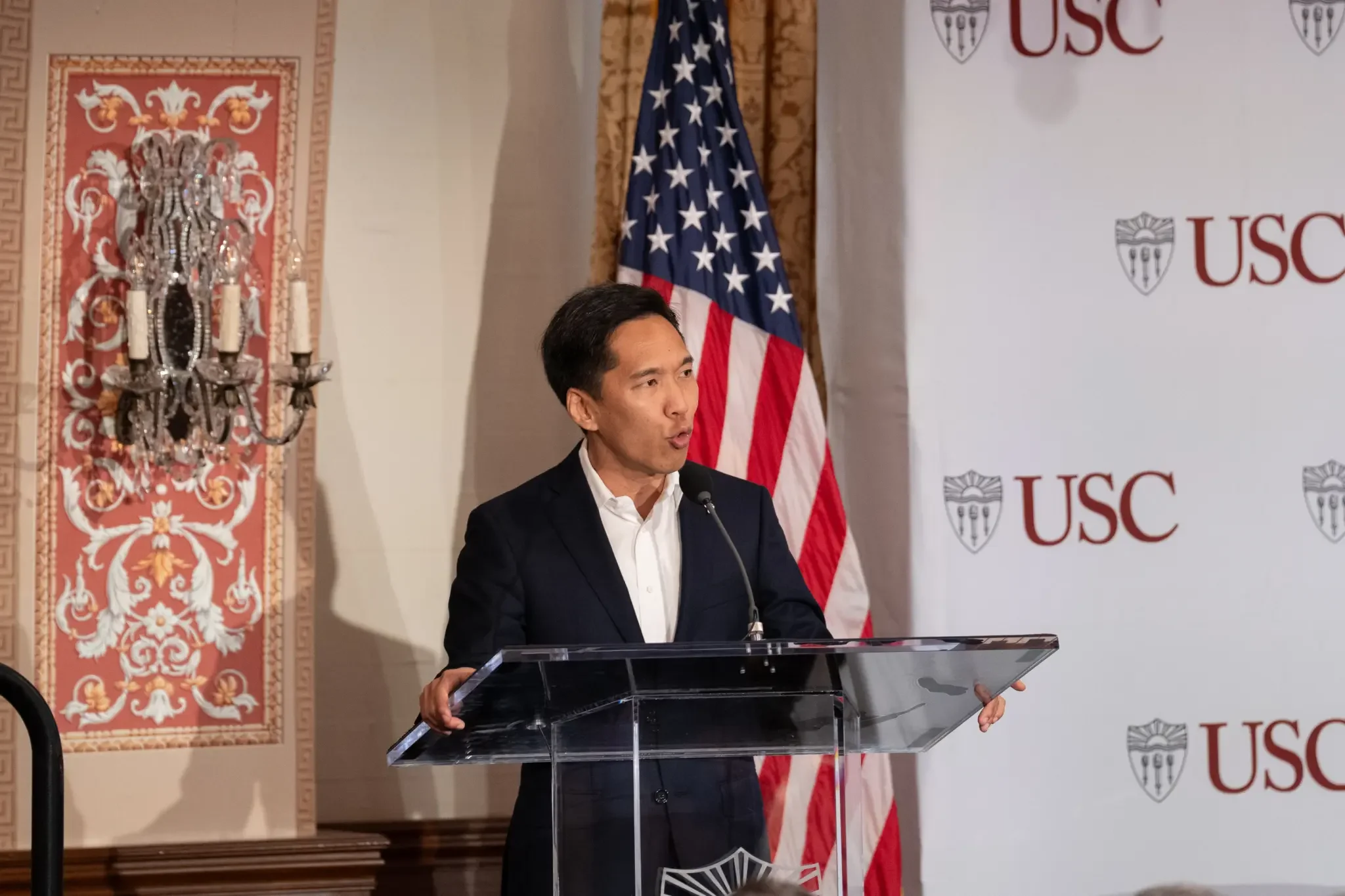
USC President Beong-Soo Kim at USC’s first International Day of Democracy. (Mallory Snyder / Daily Trojan file photo)
Institutions, like people, tend to reach for familiar tools when they are afraid. They do so not because those tools are forward-looking, but because they have worked before — because they promise an illusion of control at moments when the future seems unmanageable.
This week, USC reached for its most familiar tool: its lawyer.
The Board of Trustees’ decision to elect Beong-Soo Kim as its 13th president on Wednesday is being sold as competence and stability — the language of steadied hands and headlines. Kim is, by any conventional resume metric, qualified: a former federal prosecutor, healthcare executive and most crucially, USC’s senior vice president and general counsel for five years — the official charged with managing the University’s legal exposure during its most turbulent recent period.
His unanimous selection makes the result difficult to contest. That is precisely why it deserves scrutiny.
Leadership choices are rarely just about the person elevated; they function as institutional self-diagnoses. In periods of stability, universities entrust themselves to scholar-administrators whose authority is rooted in teaching, research and shared governance. In periods of strain, that logic often contracts.
The University has begun to define itself less by what it hopes to pursue than by what it must avoid: lawsuits, deficits, federal scrutiny, reputational free fall.
USC has been training for this outcome for years. By the time Kim stepped into the interim role, the University was already speaking in the idiom of emergency: It had a $200 million structural deficit about to be revealed and needed to take difficult actions to stabilize its perception from the federal government. As general counsel, Kim helped lead USC through hostile national attention, including the University’s brutal response to campus encampments.
In messaging surrounding USC’s finances, Kim described the deficit as “recurring” and “unsustainable,” warning that USC could not rely on tuition increases or endowment draws: The University’s challenges would require layoffs.
The message reads pragmatically, and embedded in its syntax is a worldview that the University secures its future not by expanding what it can be, but by transforming its “operating model” — the University’s view of itself.
Kim’s interviews reinforced this orientation, though in warmer language. He has repeatedly described higher education as entering an “incredibly tumultuous time,” citing federal research cuts and international enrollment anxiety. He has spoken about regrounding USC in academic excellence — a phrase that sounds reassuring until it is paired with the vocabulary of efficiency: combining resources and ensuring USC’s value is clearly conveyed to society.
Now, efficiency is the throughline in USC’s academic mission, not the pursuit of knowledge.
If you want to understand what kind of president USC believes it needs, look less at the praise and more at the decisions. In the same period of “financial resilience” that required layoffs, USC committed $3.1 million to a campus-wide ChatGPT Edu partnership — a glossy investment in technological futurity even as the University’s human infrastructure became expendable.
This is not a contradiction; it is an ideology, the belief that technological innovation is essential while labor is flexible.
This sentiment explains why Trustees described Kim as a “next generation” president. The University’s stakeholders want his ability to steer a research institution through contraction, political pressure and reputational risk without unsettling the people who foot its bills.
Kim has spoken eloquently about academic freedom, invoking the “marketplace of ideas” and the importance of prioritizing discourse, as seen in his creation of USC’s Open Dialogue Project. He emphasizes his commitment to collaboration, listening and restraint, which does matter. But they coexist with a governing posture that treats intellectual life as something to be carefully staged rather than robustly protected.
Academic freedom assumes that controversy is not merely inevitable but productive; it can expose institutional blind spots and bring in tangible improvement. In contrast, brand management treats controversy as reputational exposure; it regards messiness as a liability.
Years of lawsuits and national scrutiny have kept USC on the defensive. The institution has been burned repeatedly, and in its confusion, wisdom has increasingly erred on the side of caution. In this reflex, the quiet erosion of academic freedom is illuminated — faculty, students and alumni learn, without being told, which lines of inquiry are safer than others.
Kim did not create this condition. He inherited it. But presidents do more than oversee institutions; they model what those institutions believe is worth protecting. A lawyer-president can, in theory, defend academic freedom with ferocity. The question is whether USC is willing to tolerate the reputational discomfort that genuine intellectual openness entails.
