Residents Question Funding, Governance of Proposed Disaster Recovery District
This article was originally written for the Palisadian-Post, published May 21, 2026.
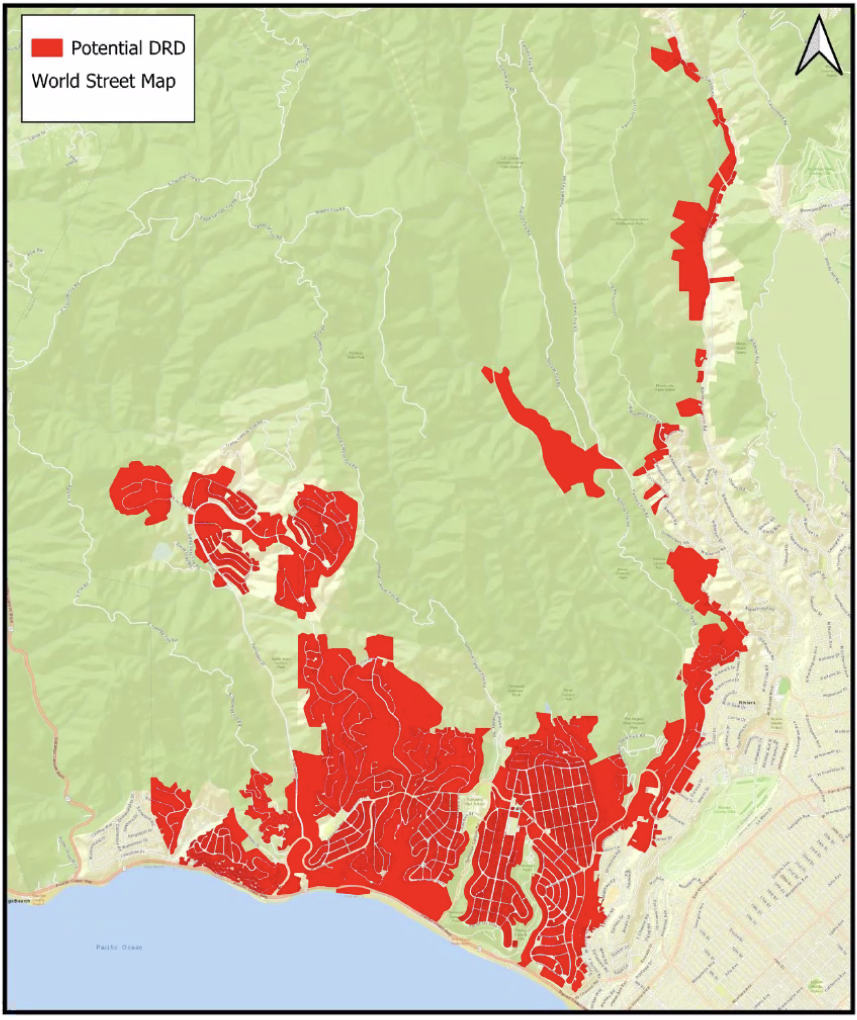
City officials presented a preliminary map of the proposed Disaster Recovery District at a Pacific Palisades Community Council meeting Tuesday. The district could generate up to $1.9 billion for infrastructure projects, but its boundaries and structure drew sharp questions from residents.
Residents joined a Pacific Palisades Community Council online meeting Tuesday night with pointed questions about who would control a proposed Disaster Recovery District, how quickly it could deliver money and whether it would jeopardize the community’s chances of securing federal funding.
The meeting, held immediately after the city’s webinar on the draft Long-Term Recovery Plan, featured Craig Bullock, Councilwoman Traci Park’s planning director; Jeff Lewis, an industrial and commercial finance officer at the city’s Economic and Workforce Development Department; and Blair Miller; chief of EWDD’s real estate group.
A Disaster Recovery District would redirect a portion of future property tax growth within the district back into the Palisades for infrastructure and recovery projects, rather than sending that revenue to the city’s general fund. A preliminary study cited in the city’s draft recovery plan found the district could generate between $325 million and $1.9 billion over its term, though a more detailed feasibility study conducted by Kosmont Companies is expected by the end of the summer.
Bullock called the district essential to avoiding a fragmented recovery.
“Otherwise, we’ll either have an unfunded recovery or we’re going to have a patchwork of recovery as funds become available,” Bullock said.
Lewis explained that the DRD, authorized by state Senate Bill 782 in October 2025, has broader authority than other tax-increment-funded districts. According to Lewis, the DRD could fund low-interest loans to uninsured or underinsured homeowners, as well as workforce training and commercial reconstruction—categories not eligible for funding under a standard Climate Resilience District. A DRD, said Lewis, can also issue bonds backed by future tax-increment revenue to accelerate near-term projects.
Under the legislation, the district’s governing board would include three elected city officials and two appointed residents—or a mix of city and county officials if Los Angeles County joins in the district. Several attendees questioned whether that structure gave the community enough control.
“One thing that I think this community needs to be assured of is maximum transparency in all this,” said an attendee during the question-and-answer period. “We need to know why people are being appointed, how they are being appointed, do we have input on that?”
Bullock pledged to continue working with the PPCC on the appointment process and said the governing board would be subject to the Brown Act, meaning all meetings would be public.
A recurring concern was whether establishing a DRD would give the federal government a reason to withhold disaster recovery funding. Bullock pointed to the 1994 Northridge earthquake, when the federal government continued allocating resources to L.A. despite the establishment of tax-increment districts for the same area.
“They actually were complementary because it showed a commitment by the city for the recovery of the area, not relying solely on the federal funds,” Bullock said.
Miller cautioned that the DRD is “not one of the fast tools when it comes to raising money.” According to Miller, tax-increment funding takes at least two years to begin generating meaningful revenue. That frustrated some attendees who said they needed help now, particularly as additional living expense payments and mortgage forbearance periods run out.
The meeting also surfaced concerns about the district’s proposed boundaries. Multiple attendees said the preliminary map appeared to exclude parts of the Palisades that suffered smoke damage or are located along critical evacuation routes. Lewis said the boundary was drawn based on parcels with physical damage or lost assessed value but acknowledged there is the possibility of reconsidering the boundaries.
The DRD would need approval from a majority of the 15-member Los Angeles City Council—a hurdle Bullock recognized as difficult, referencing the permit fee waiver fight earlier this year in which some council members balked at directing resources to the Palisades. Bullock argued that an expeditious Palisades recovery is in the interest of those council members, too, because it would restore property tax revenue that flows to the general fund.
Hours before the meeting, the L.A. County Board of Supervisors voted unanimously to formally establish a Disaster Recovery Rebuild Authority focused on the unincorporated Santa Monica Mountains and Altadena. The authority, co-authored by Supervisors Lindsey Horvath and Kathryn Barger, took immediate effect and will be housed in the county’s Department of Public Works. Horvath represents the Palisades area at the county level, and the Santa Monica Mountains border the community, meaning the county has now established its own recovery authority on land adjacent to the city’s proposed DRD while the city’s feasibility study is still months from completion.
The city’s Economic and Workforce Development Department expects to present the completed study to the community by the end of the summer and then to the city council in early fall. If approved, the DRD could begin formation proceedings by late fall.
