Long-Term Recovery Plan Outlines Path for Palisades Businesses but Funding Remains Scarce
This article was originally written for the Palisadian-Post, published May 18, 2026.
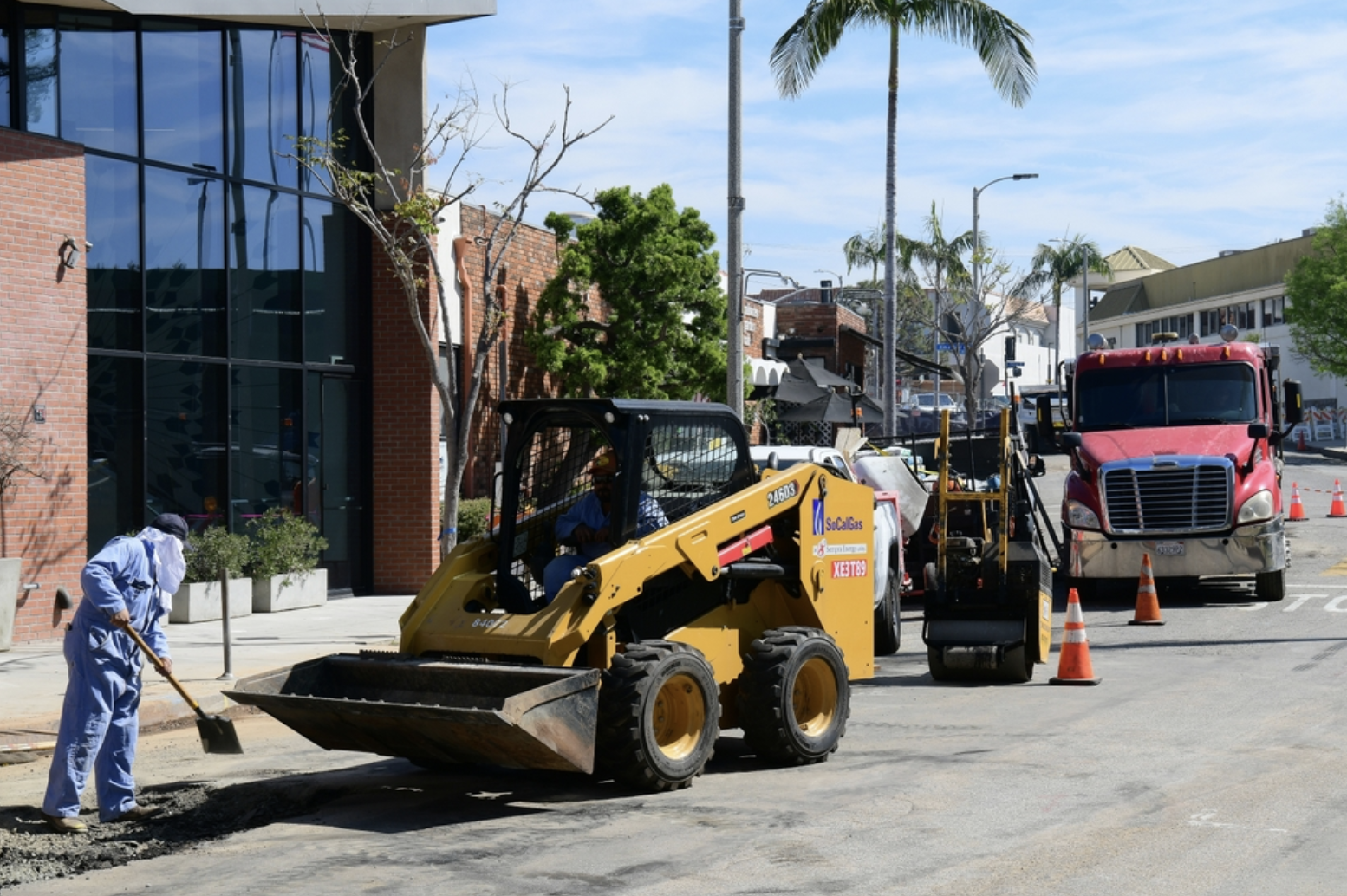
A crew from Southern California Gas does repair work earlier this spring in the 15200 block of La Cruz Drive in Pacific Palisades. Photo by Rich Schmitt/Palisadian-Post
The city’s draft Long-Term Recovery Plan for Pacific Palisades envisions a commercial district where small business owners have access to low-interest loans, reliable data on how many residents have returned and a trained local workforce ready to rebuild the neighborhood. But turning that vision into reality will require money the city does not have.
Of the nine economic recovery projects in the plan, seven are unfunded. The document, developed with consulting firm AECOM and released Friday, lays out what the Palisades business community needs to recover while acknowledging that most of the tools to deliver it do not yet exist.
The plan identifies the central challenge facing local businesses plainly: uncertainty about when displaced residents will come back. For an owner deciding whether to sign a lease or rehire staff, not knowing if enough customers will return makes every investment a gamble. To close that gap, the plan proposes a population tracking system that would pull data from the Department of Building and Safety, the Department of Water & Power and the United states Postal Service to estimate how many households have returned.
The plan also calls for a dedicated business survey, noting that only 32 businesses responded to the community-wide survey conducted during the LTRP’s development—a response rate that the plan acknowledged was not a large enough sample for making firm conclusions. Those that did respond said a lack of customers, insufficient rebuilding funds and permitting delays were their biggest obstacles.
If the plan’s proposals come together, a business owner trying to reopen could access new grant or loan programs tailored to the Palisades—an area where several existing city lending programs do not apply because their funding is restricted to low- and moderate-income communities. A surge workforce plan would train local workers to fill rebuilding jobs, and a technical assistance program would help owners navigate permitting, insurance claims and lease negotiations.
The largest potential funding source is a proposed Disaster Recovery District authorized by California Senate Bill 782, which a preliminary study estimated could generate between $325 million and $1.9 billion for infrastructure projects using incremental property tax revenue. A feasibility study by Kosmont Companies is underway, but the draft plan flags concerns about the mechanism’s impact on the city’s general fund.
According to the plan, early relief programs did reach hundreds of businesses in the first year after the fire. A total of 903 small businesses received a combined $8.2 million through the L.A. Region Small Business Relief Fund, and 80 received $5,000 grants through the L.A. Economic Development Corporation’s Fire Recovery & Resilience Initiative. But those programs have closed, and the plan frames its proposals as the bridge between that initial aid and long-term stability.
The most visible sign of commercial recovery, however, is happening outside the city’s plan. Developer Rick Caruso has invested more than $50 million to renovate Palisades Village, the 42-business shopping center on Sunset Boulevard that has been closed since the fire despite surviving largely intact. Erewhon, Elyse Walker and a new restaurant from James Beard Award-winning chef Nancy Silverton are all slated to open there this summer—funded entirely without city dollars.
The contrast underscores the plan’s biggest vulnerability: If the city cannot secure funding for its proposals, the Palisades’ commercial recovery may depend largely on private investment and individual initiative rather than the coordinated public effort the draft plan describes.
The economic section sits within the larger 295-page document that covers six areas of recovery. A public webinar on Tuesday, May 19, at 5 p.m. will give residents and business owners the chance to ask questions about the plan; those interested can register here. Written comments will be accepted through June 29 by email at palisadescommunity@aecom.com or on the city’s recovery website.
