A Life In and Out of the Box
This article/book review was originally written for WRIT-340: Advanced Writing for Editors, Writers, and Publishers in Spring 2026. It is a part of the course’s final portfolio, in conjunction with a personal essay.
The novel convincingly builds the social “box” around Yosano Akiko, but the struggle inside occasionally settles into repetition.
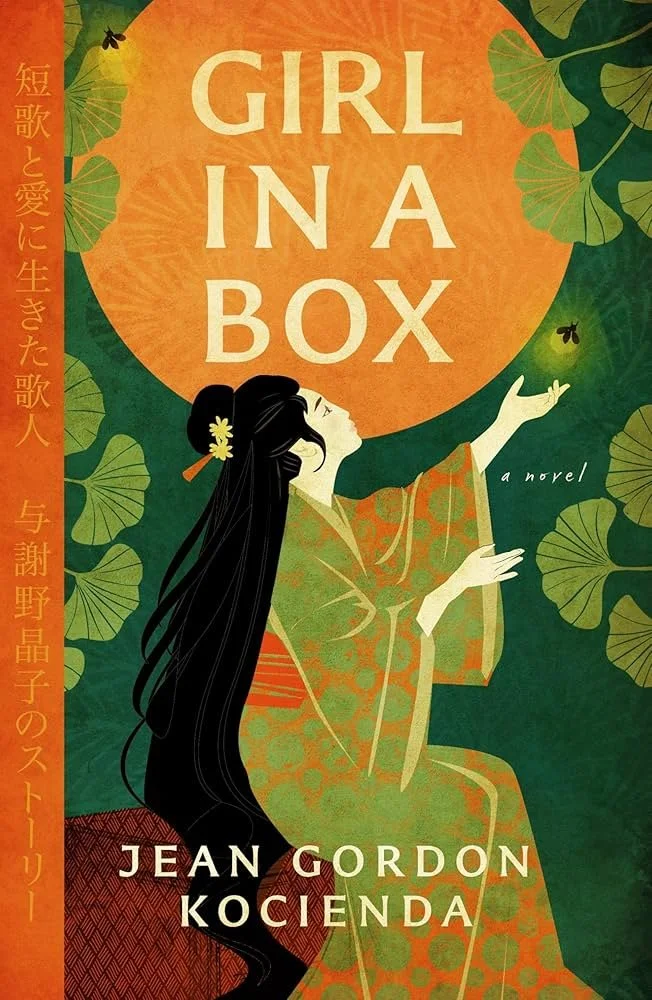
“Girl in a Box: The Tangled Life of Japanese Poet, Yosano Akiko” | by Jean Gordon Kocienda | April 21, 2026 Sibylline Press | Buy on bookshop.org
Jean Gordon Kocienda’s debut novel, “Girl in a Box: The Tangled Life of Japanese Poet, Yosano Akiko,” begins from an arresting premise: that the life of one of Japan’s most influential modern poets can be understood as a prolonged negotiation with confinement — not a single dramatic rebellion, but a series of incremental decisions made within the constraints of family, reputation and gendered expectations.
The novel is at its most persuasive when it renders those pressures as lived experience rather than abstract themes, showing how limitation settles into daily routine and becomes difficult to distinguish from normalcy. Yet the book’s central tension — the effort to sustain an artistic, individual identity within the structure of domestic responsibility — is not always carried forward with equal force. Kocienda succeeds in establishing the “box” that surrounds Akiko’s life, but she does not consistently sustain the sense of friction that would make the struggle inside it feel urgent across the novel’s brief 290-page span.
The title refers to the hako-iri musume — the sheltered daughter whose movements and choices are carefully managed until marriage transfers responsibility from one household to another. Kocienda treats this cultural framework with seriousness, capturing the metaphor’s essence as a system of expectations that shapes behavior long before it is consciously understood. Sho, not yet the poet Akiko, grows up in a merchant family in Sakai where her life is carefully dictated for her by family expectations of obedience coupled with burdensome, copious amounts of caution. Her parents are attentive and pragmatic, concerned with stability and reputation in a society where both can be lost quickly. Sho’s father, Sosuke, runs the family confectionery business with an emphasis on discipline and order, and his expectations for his daughters follow the same logic. Tsune, her mother, reinforces those expectations through quieter forms of guidance, reminding Sho that a woman’s reputation can determine her entire future. Within that environment, the boundaries of her future are drawn firmly but quietly, and Kocienda captures with precision the subtle ways in which those boundaries become internalized.
What distinguishes Sho from those around her is not defiance in any overt sense but an unusual attentiveness to language, an awareness that words carry possibilities unavailable elsewhere. She reads compulsively, memorizes lines of poetry and begins to write in secret, unsure whether the activity will ever be permitted or even understood. Early in the novel, she reflects that poetry offers her “a place where no one could follow,” a phrase that encapsulates the paradox of her creative life — simultaneously private and expansive, hidden yet deeply consequential. Kocienda allows this realization to unfold without dramatization, trusting the reader to recognize its significance, and in doing so she establishes Akiko’s action of writing as the novel’s primary engine of transformation.
The narrative gains noticeable momentum once Sho enters the literary world, particularly through her relationship with Yosano Tekkan, the poet and editor who becomes both her mentor and eventual husband. Their conversations about form, emotion and publication are among the most compelling sequences in the book because they place intellectual exchange at the center of the story. Tekkan challenges her work directly, urging her to write with honesty rather than caution, and his criticism forces her to confront the limits of her own restraint. These exchanges carry emotional weight not because they signal romance — though romance eventually follows — but because they mark the first time Sho is taken seriously as a writer.
Kocienda situates these interactions within a broader network of literary figures, including Tekkan’s first wife, Tomiko, whose presence complicates the narrative in ways that extend beyond simple rivalry. Tomiko’s disappointment and anger are rendered with sympathy, reminding the reader that Sho’s pursuit of artistic fulfillment carries consequences for others. The novel is at its most nuanced when it acknowledges these competing claims on loyalty and affection, showing how personal ambition can disrupt existing relationships even when that ambition feels justified.
Historical detail reinforces this complexity. Tokyo appears as a city in motion, its streets crowded with students, printers and journalists eager to participate in the cultural shifts of the early 20th century. Newspapers circulate new ideas about modernity and gender, while literary magazines provide a platform for voices that might otherwise remain unheard. Kocienda integrates these elements smoothly into the narrative, allowing them to shape the characters’ decisions without overwhelming the story’s emotional focus.
The domestic sphere, however, receives a level of attention that sometimes disrupts this forward movement. After Sho marries Tekkan and begins raising their children, the narrative returns frequently to scenes of household management — preparing meals, tending to illness and negotiating the daily logistics of family life. These scenes accurately reflect the demands placed on a working mother in early 20th-century Japan, particularly one attempting to maintain a literary career alongside domestic responsibilities. Yet the repetition of similar tasks can create the impression that the story has paused rather than progressed. The reader understands quickly that writing must be squeezed into limited hours, often late at night after Tekkan and the children have gone to sleep.
Sho herself articulates this condition with striking clarity when she observes that she writes “in the narrow spaces left after everything else.” The novel has revealed how little time remains once her domestic obligations are fulfilled. Kocienda’s challenge lies not in the accuracy of this depiction but in its persistence; by returning repeatedly to the same cycle of duty and exhaustion, the narrative risks flattening the tension it seeks to sustain.
This imbalance becomes particularly evident in the chapters following the birth of Sho’s children. Tekkan continues editing manuscripts and engaging with literary circles, while Sho balances motherhood with writing deadlines, often sacrificing sleep to maintain productivity. The strain on their relationship is palpable, yet it rarely erupts into open conflict. Instead, the tension between them manifests in quieter ways — unfinished conversations, postponed ambitions and steady accumulation of fatigue. These details ring authentically, but they also slow the story’s rhythm, making subsequent progress difficult to perceive.
By contrast, scenes tied to Sho’s literary achievements restore a sense of urgency almost immediately. Her first major publication in Tekkan’s journal marks a turning point not only in her career but in her sense of identity. Holding the printed page, she begins to understand that her words, her life’s work, now exist beyond the household that once defined her boundaries. The transformation is subtle yet unmistakable, and the reader feels the expansion of possibility that accompanies this sense of recognition.
Kocienda is particularly effective in portraying the consequences of that recognition through specific relationships rather than generalized social pressure. Tekkan’s colleagues in the literary community respond with admiration tempered by skepticism, unsure whether a woman can sustain serious artistic work while managing a family. Sho’s parents express concern about the public attention surrounding her poetry, fearing that controversy could damage the family’s reputation. Even Tomiko’s lingering presence in Tekkan’s life serves as a reminder that personal success rarely occurs in isolation; the tension from these competing loyalties feels historically credible.
The question of authorship extends beyond the character of Akiko herself and into the novel’s own construction. Kocienda approaches her subject as an outsider, a white woman who studied in Japan and learned to speak the language, to the culture she depicts, and her commitment to accuracy is evident in the careful explanation of customs, rituals and literary traditions. However, at times, that impulse becomes visible enough to interrupt the flow of storytelling. The reader becomes acutely aware of Kocienda guiding their interpretation, which does not undermine the story’s credibility, but does shift attention away from the characters’ experiences.
The closing image draws on the Japanese art of kintsugi, in which broken pottery is repaired with gold so that its fractures remain visible. Sho studies a repaired bowl and recognizes in its seams a record of persistence — evidence that damage can become part of a structure’s strength. This metaphor reflects the novel’s central insight: that endurance, not escape, defines Akiko’s life.
Whether “Girl in a Box” fully captures the tension within Yosano Akiko’s life ultimately depends on how one evaluates the balance between constraint and movement. Kocienda succeeds in portraying the social and familial forces that shaped her protagonist, grounding the story in well-written interpersonal relationships. Unfortunately, the narrative does not always sustain the momentum required to keep those forces in dynamic tension. Akiko’s “box” remains visible throughout the novel, carefully constructed and historically convincing, but the struggle inside it sometimes settles into routine.
Even so, the book offers a thoughtful and carefully researched portrait of a writer who transcended all expectations of her and fought through pressure to remain silent. The box surrounding Akiko’s life remains firmly in place, but the act of writing gives it new meaning, reminding the reader that ambition must often coexist with limitation, because, as Sho recognizes, “There was always more work than time.”
Julia Ho is a third-year student at the University of Southern California studying public relations and advertising.
